
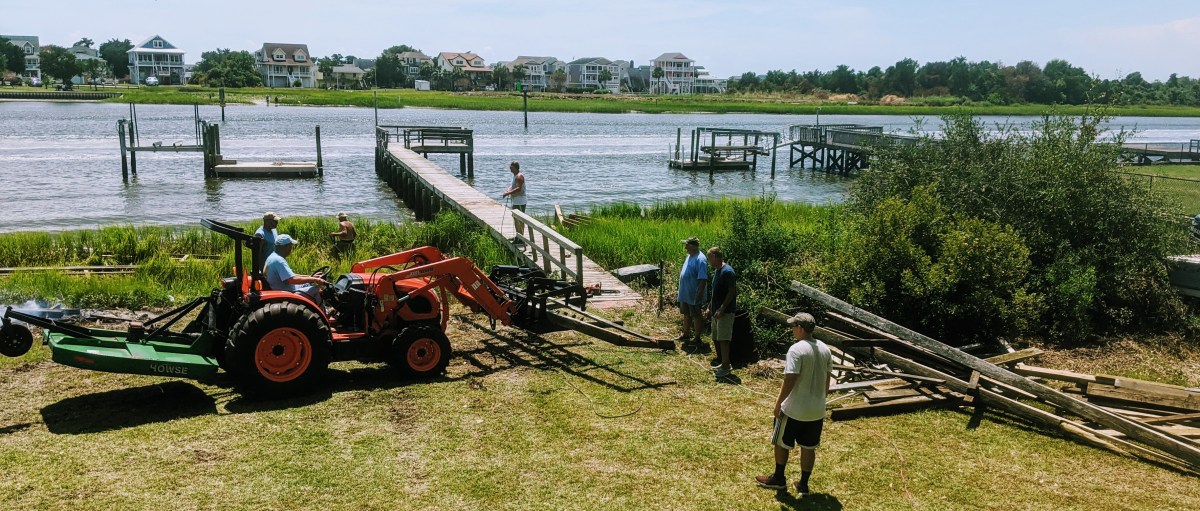
Last Saturday, Tom Dixon called me, exhaustion in his voice. “Come over and take some photos. It’s a good example of neighbor helping neighbor.” So I rushed over with my trusty Pixel.
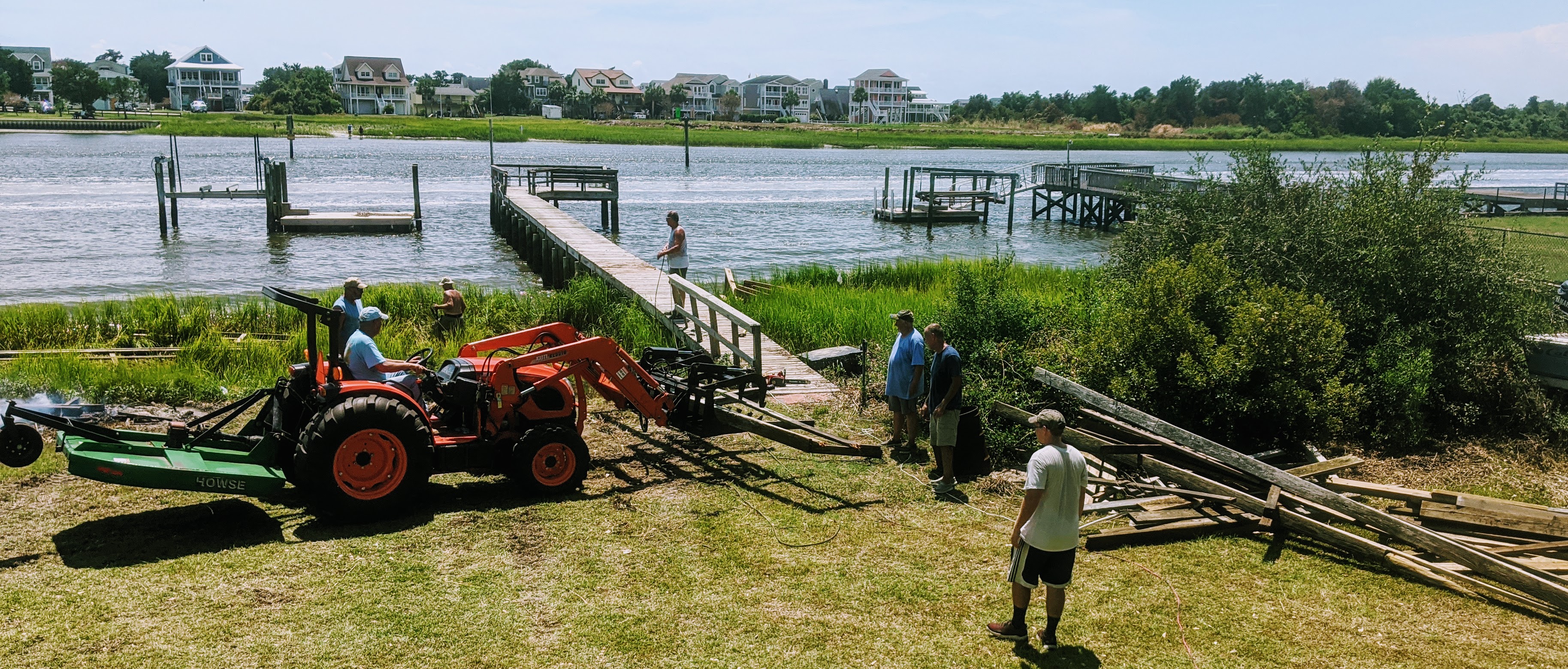
When I arrived, a carrot-colored, commercial-grade tractor was lifting and relocating sections of the next-door-neighbor’s pier that had landed on Tom’s pier. Hurricane Isaias had blown the structure’s railing and floor sideways, onto Tom’s property, resulting in downed railings and scattered posts.
Eight or 10 neighbors were there, waiting to contribute as needed. They’d been working all morning before the tractor arrived, and on and off for several days earlier in the week. One chore had been to saw up and remove parts of Tom’s pier from another neighbor’s lawn. They’d already cut the pier debris into sections, pulled some of it out of the marsh and yard by hand, and had generally done as much as possible before the big carrot drove up.
No one had asked for nor expected money. As Tom said, they were just neighbors helping neighbors. Even the tractor operator lived down the street. Later he brought in a cherry-picker for materials too far out in the water for the tractor to reach. I’m pretty sure some remuneration will be made for the equipment costs, but the work was voluntary.
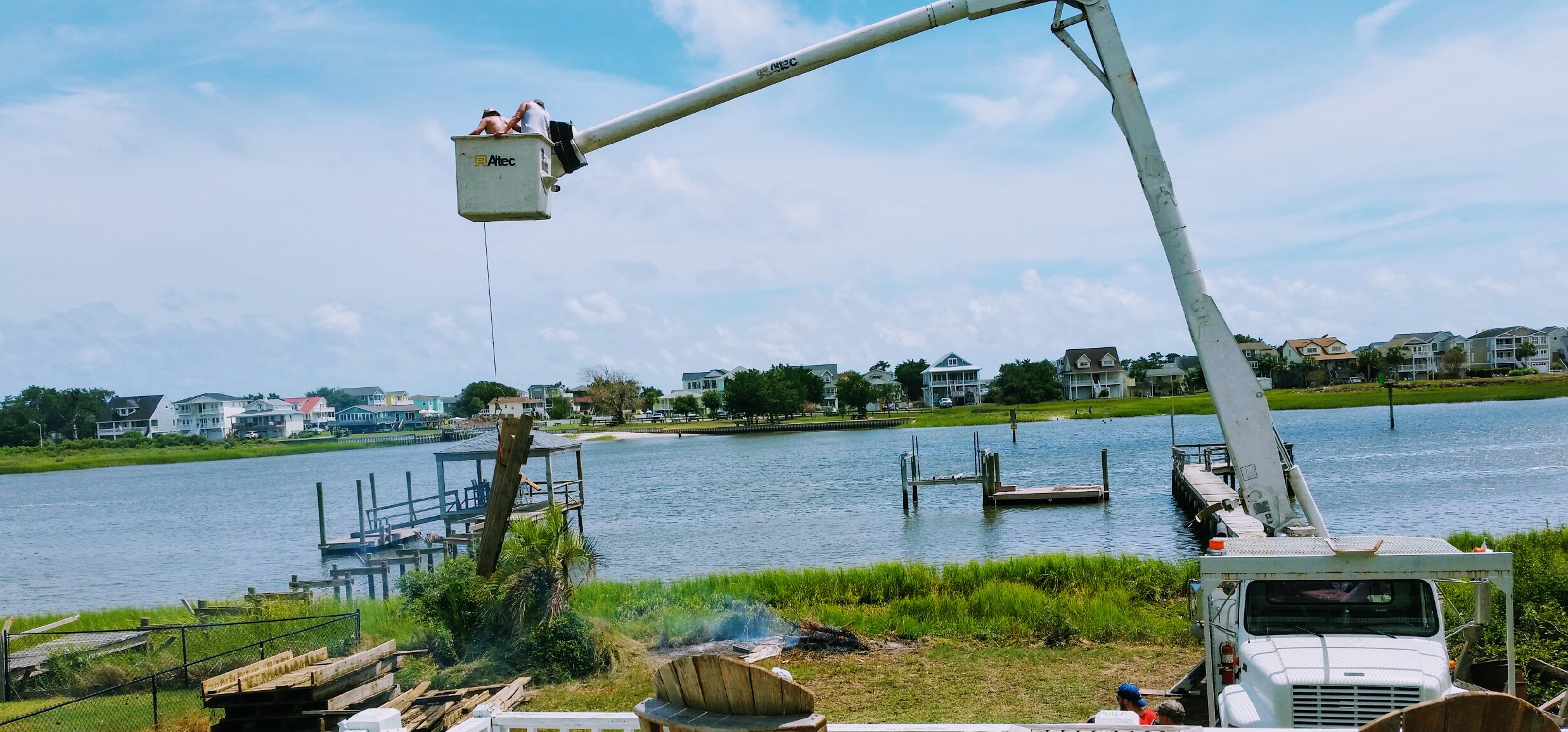
Except for the big-boy toys, I found the presence and persistence of the men unsurprising. Tom and his neighbors, men and women, routinely share their tools and talents, so Saturday’s story was a good photo op, but non-news from my perspective. Still, it was an uplifting story.
After catastrophes, journalists always report with amazement how neighbors are assisting each other during the tragedy. They are even more astonished when stranger is helping stranger. During a flood, boating up to someone’s roof to rescue them. Or wrapping children in blankets and carrying them to safety in blizzards or volcano eruptions.
Can you even imagine helping someone you don’t know who’s in trouble? Of course, you can!
It’s called being a decent human being and it happens all the time in daily life. It’s why we take Red Cross CPR classes, so we’re prepared to help someone, anyone who stops breathing. It’s why we stop when we see a car accident, to call emergency responders and help those who’re hurt until professionals arrive.
You help strangers. I help strangers. Strangers help us. I don’t know how I’d get through a week without others’ generous spirits.
Sometimes we help without even thinking about it – we just do it. And sometimes that help is truly heroic – sacrificing one’s life for a stranger. I don’t know that I’m brave enough to do that, but it doesn’t surprise me that many people are.
Psychologists would lay much of this goodwill at the feet of reciprocity. That trait that humans have evolved in order for society to function more smoothly. In the long run, reciprocity usually helps individuals, too, to survive and thrive.
In Tom’s case, reciprocity might’ve been involved. Certainly, he’s helped many of his neighbors over the years and made his pier available for others to fish from. And they’ve helped him, too. Deep inside themselves, some neighbors might have been responding to his earlier kindnesses or hoping for future help with their own problems.
Some of the neighbors’ kindness may have been due to religious or moral codes. They were living the universally quoted but less-often followed, “Love your neighbor” and “Do unto others as you would have them do unto you.”
Psychologists and preachers and philosophers are probably all correct, but I propose that neighbor-helping-neighbor is simpler. Helping our neighbors, next door or across an ocean, just feels like the right thing to do. For me, it makes me feel like I’m worth the space I inhabit on this Earth.
 Twists and Turns