Blog

My son and I aren’t best friends

Facebook is filled with motherly comments, glowing about their adult children who are their BFFs. I’m envious when I read those posts, wondering why my child and I aren’t best friends. Am I doing something wrong?

April 2020, Blake and Bastion

Blake and I are friendly but I’m not even sure we’re . . . friends. We like each other, love each other, respect each other, listen to each other’s stories. But we don’t divulge intimacies like my friends and I do.

Our conversations cover the usual – the humor and trials of work and family life, politics, solutions for practical matters. There’s plenty of back-and-forth. Sometimes we agree, sometimes not. Either way, he speaks to me directly, occasionally bluntly. And these days, we often exchange advice on issues about which one of us is more knowledgeable than the other.

Oct 31, 2019 – Blake, Thanh, & Bastion

On luxuriously long video chats, Blake and my daughter-in-law Thanh regularly share themselves and son Bastion with Dad and me. These chats allow the little one, his grandma, and great-grandpa to get to know each other. And they make me appreciate Bastion’s parents even more. But that doesn’t make my son and I BFFs.

When I mentioned some of these thoughts, Thanh suggested it might be the difference between mother-son and mother-daughter relationships. Yes, I agreed, most of the FB comments seem to be by mothers about their daughters. I felt better.

Blake agreed that “friendship” doesn’t describe our relationship accurately. “We’re not friends, Mom, but we’re not not friends either,” he said. “We do things that friends do – our trip to Big Bend, having a drink together. It’s just a different space.”

He added that circumstances have created some distance. Literally. We live about 1500 miles apart. Plus, he and Thanh have had time-consuming jobs, and now parental responsibilities. That makes it difficult for us to spend relaxed time together. It’s especially frustrating this year when I can’t visit with toddler Bastion, who’ll probably be a foot taller by the time I’m able to squeeze him and kiss that precious little neck.

Then there’s the fact that Blake and Thanh have been a couple since their freshman years at UNC, so they’ve turned to each other their entire adult lives. She’s his BFF, and so far, their lives have chugged along pretty smoothly. I’d like to believe that Blake just hasn’t needed to rely on me emotionally.

I’ll end with a quote from Dorothy Canfield Fisher that I’d like to believe is true for my son and me . . . .

“A mother is not a person to lean on, but a person to make leaning unnecessary.”

I’m good with that.
Why do we help?

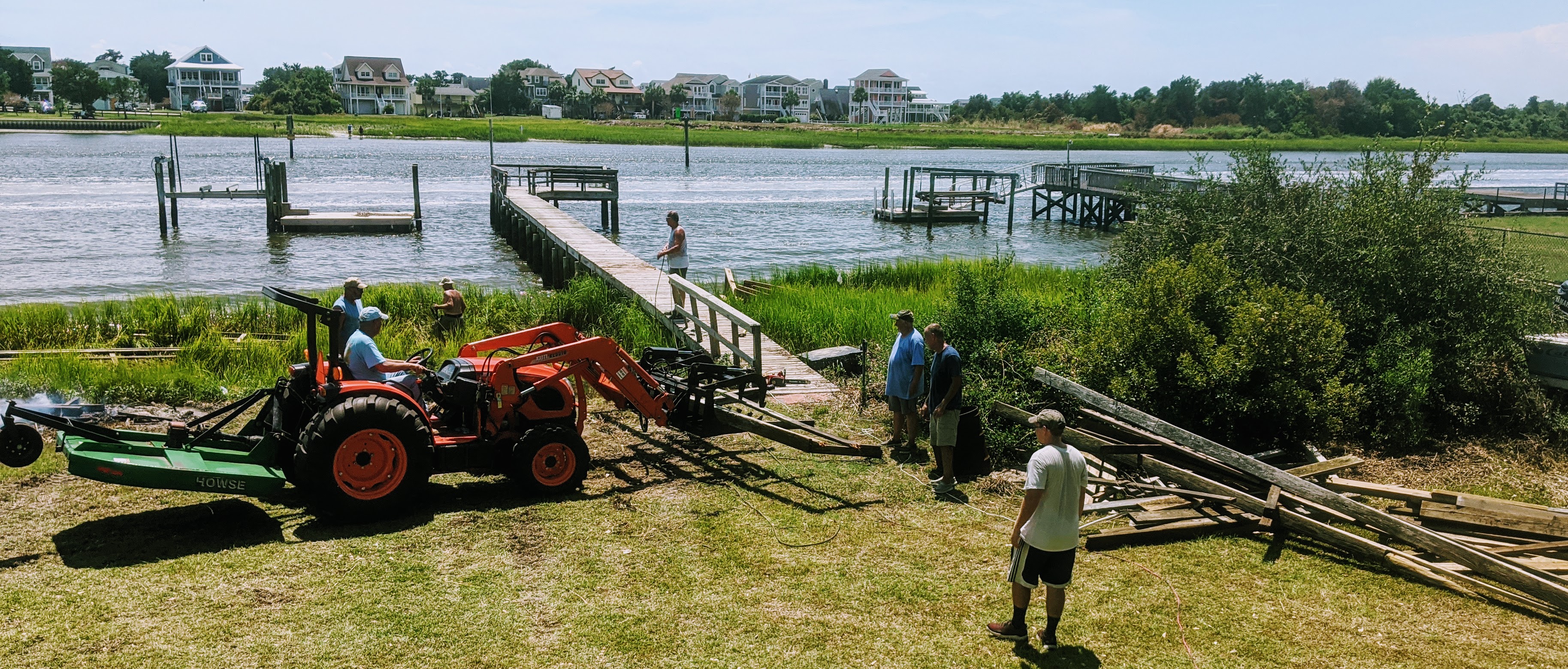
Last Saturday, Tom Dixon called me, exhaustion in his voice. “Come over and take some photos. It’s a good example of neighbor helping neighbor.” So I rushed over with my trusty Pixel.

Aug. 15, 2020. Neighbors removing destroyed pier from Tom’s pier and marsh.

When I arrived, a carrot-colored, commercial-grade tractor was lifting and relocating sections of the next-door-neighbor’s pier that had landed on Tom’s pier. Hurricane Isaias had blown the structure’s railing and floor sideways, onto Tom’s property, resulting in downed railings and scattered posts.

Eight or 10 neighbors were there, waiting to contribute as needed. They’d been working all morning before the tractor arrived, and on and off for several days earlier in the week. One chore had been to saw up and remove parts of Tom’s pier from another neighbor’s lawn. They’d already cut the pier debris into sections, pulled some of it out of the marsh and yard by hand, and had generally done as much as possible before the big carrot drove up.

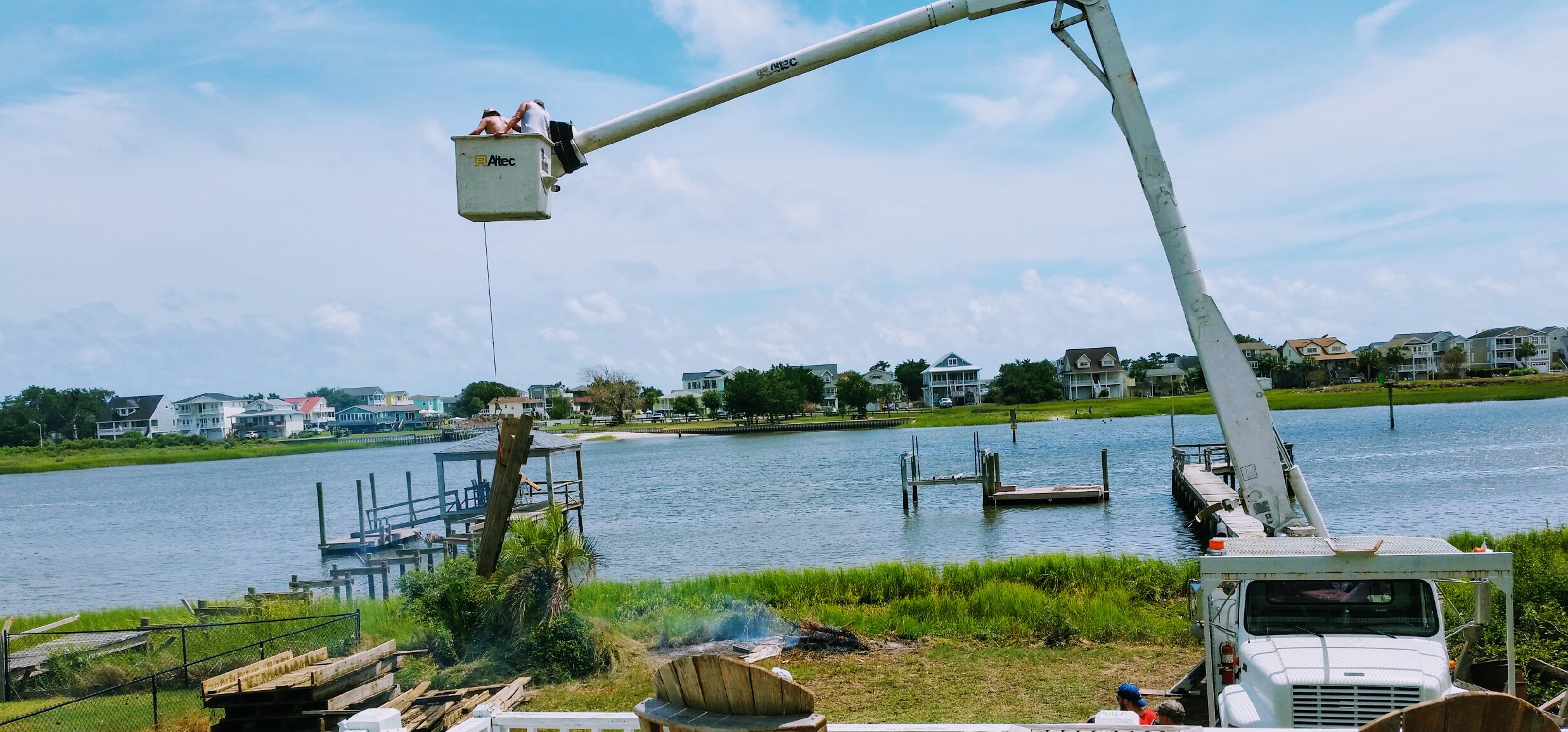
No one had asked for nor expected money. As Tom said, they were just neighbors helping neighbors. Even the tractor operator lived down the street. Later he brought in a cherry-picker for materials too far out in the water for the tractor to reach. I’m pretty sure some remuneration will be made for the equipment costs, but the work was voluntary.

Aug. 15, 2020. Cherry picker moving sections of destroyed pier on the Intracoastal Waterway.

Except for the big-boy toys, I found the presence and persistence of the men unsurprising. Tom and his neighbors, men and women, routinely share their tools and talents, so Saturday’s story was a good photo op, but non-news from my perspective. Still, it was an uplifting story.

After catastrophes, journalists always report with amazement how neighbors are assisting each other during the tragedy. They are even more astonished when stranger is helping stranger. During a flood, boating up to someone’s roof to rescue them. Or wrapping children in blankets and carrying them to safety in blizzards or volcano eruptions.

Can you even imagine helping someone you don’t know who’s in trouble? Of course, you can!

It’s called being a decent human being and it happens all the time in daily life. It’s why we take Red Cross CPR classes, so we’re prepared to help someone, anyone who stops breathing. It’s why we stop when we see a car accident, to call emergency responders and help those who’re hurt until professionals arrive.

You help strangers. I help strangers. Strangers help us. I don’t know how I’d get through a week without others’ generous spirits.

Sometimes we help without even thinking about it – we just do it. And sometimes that help is truly heroic – sacrificing one’s life for a stranger. I don’t know that I’m brave enough to do that, but it doesn’t surprise me that many people are.

Psychologists would lay much of this goodwill at the feet of reciprocity. That trait that humans have evolved in order for society to function more smoothly. In the long run, reciprocity usually helps individuals, too, to survive and thrive.

In Tom’s case, reciprocity might’ve been involved. Certainly, he’s helped many of his neighbors over the years and made his pier available for others to fish from. And they’ve helped him, too. Deep inside themselves, some neighbors might have been responding to his earlier kindnesses or hoping for future help with their own problems.

Some of the neighbors’ kindness may have been due to religious or moral codes. They were living the universally quoted but less-often followed, “Love your neighbor” and “Do unto others as you would have them do unto you.”

Psychologists and preachers and philosophers are probably all correct, but I propose that neighbor-helping-neighbor is simpler. Helping our neighbors, next door or across an ocean, just feels like the right thing to do. For me, it makes me feel like I’m worth the space I inhabit on this Earth.

High School Geography

Today a short video of one of my Ferguson High School teachers popped up on Facebook.

In the FB clip, geography aficionado, Gil Crippen (“Mr. Crippen” to me), was enthusiastically discussing a student trip to the Mideast. He was waving an indigo head covering (not blue, specifically “indigo,” possibly dyed using the local indigo plants) that the desert dwellers would wrap around their heads for protection from sun and sand.

In my 1970 memories, seldom a sentence was spoken by Mr. Crippen without a prop and a big map. Among other things, he taught us how the land, water, and weather intertwined, and why it was critical that we care for the land and water. It was my introduction to caring about the environment, although I didn’t realize it at the time.

We learned how rivers built trade, how trade created cities, how cities expanded economies on that river and far beyond. I probably learned more about practical economics in his class than I did in graduate-level econ.

In tenth grade, I enjoyed Mr. Crippen’s class but I didn’t care much about geography. Much to my surprise! those lessons lasted long beyond the final exam. Now I believe that geography is one of the most useful classes I ever took. Certainly, for this English major, it was more practical than calculus (apologies to Mr. Lebold).

Even with GPS, we use geography every day. On a normal work day, we use it to estimate lengths of commutes and the most efficient traffic routes. Knowing how to read a map helps us understand where our out-of-town grammies live in relation to our own houses. (“Are we there yet, Dad?” “NO! Look at the map!”)

Geography helps us prepare for bad weather, such as our recent Hurricane Isaias. Which neighborhoods are most likely to flood in our towns? Should we buy a less expensive house on this low land or a more expensive one higher up? Checking a topographical map prevents us from ruining our vacations with hikes that are too long or arduous for our couch-bound bodies.

We can’t grasp the daily news without a good grasp of geography. Why is the Mideast so important and fraught with antagonism? It’s what’s underneath the sand. Why is Afghanistan so difficult to get control of? Have you looked at that craggy, unforgiving terrain? Why do people disagree so vehemently about underwater drilling in AK and windmills off the NC beaches? It’s about how trade and the environment collide.

History is ALL about geography. About who lives near whom and which of them has oil versus lithium versus food. Some nations are protected from aggressors by immense mountains or deserts. Others are separated only by rivers or plains so they’re easier to access when one country becomes envious of the other.

Read Guns, Germs, and Steel, by Jared Diamond, if you think your clan is naturally smarter than the others. Don’t get cocky – it’s not the people, it’s the geography that allowed one civilization to take the historical lead over another.

So thank you, Mr. Crippen, for giving me and thousands of other young minds an appreciation of our world’s geography. You did it with joy and enthusiasm and with the realization that someday we’d transform some of that 10th grade information into adult knowledge.

E Coast and W Coast dangers met here last week

The first week of August was a doozy in North Carolina.

It started with a hurricane on our coast and ended with an earthquake near the Blue Ridge Mountains. Our typical east coast storm was juxtaposed against the earthy rocking and rolling more typical on the west coast.

It made me wonder: Is it more frightening and worrisome facing nature’s power when you know what’s coming or when you don’t?

Here in SE NC, punishing hurricanes are an annual summer-fall tradition. Although each storm is different, we understood what Isaias might deliver.

We knew we needed to move up as much stuff as possible and tie down everything else. Then we ourselves hunkered down inside, while the wind and rain and surf acted up outside.

Earthquake Damage: Chimney collapsed at Little River Bridge. Highway 21 south of Sparta, NC
Aug 9, 2020. Western NC house damaged by earthquake near Sparta.

On the other hand, Sparta NC residents had probably never literally experienced the earth moving under their feet. The ground had been jittery for a couple of weeks but a serious earthquake? That was new. And they hadn’t had the days of warning the coast had had to prepare.

I have a little trailer about a mile off the Atlantic, but I wasn’t worried because it’s never had much weather damage. Others aren’t so fortunate.

My beau Tom lives on the mainland, directly on the Intracoastal Waterway. Even normal high tides occasionally creep up to his patio. Only a narrow barrier island stands between him and the smashing ocean waves.

In October 2016, Hurricane Matthew left a mess along the eastern Carolinas. It brought down some of Tom’s oaks. It temporarily deposited 20″ of salt water and rain in his basement, insulation, outdoor equipment, and boxes filled with thousands of the little things we all store away for tomorrow. It was demoralizing.

I had seen the devastation Matthew left at Tom’s and at our friends’ up and down our shores. Cleaning up was emotionally exhausting for them, some of whom had already experienced Hazel in 1954, Hugo in ’89, Fran in ’96, and others.

Then last week, little Isaias flew in for a brief visit and deposited twenty-nine inches of sea water in Tom’s basement. Even more inches at others. It also deposited one neighbor’s pier directly on top of Tom’s pier, and parts of Tom’s pier on the far side of his other neighbor’s trees.

Aug 3, 2020. Neighbor’s pier laying on Tom’s pier. Tom’s boat ramp had also been lifted up and away.

I was worried for Tom, thinking how I would’ve felt. How was he going to handle this – again – knowing the months of physical, financial, and administrative hassles ahead?

By early Tuesday morning, Aug. 4, the storm had already moved NW, and the day was clear and sunny. Household by household, Tom’s neighborhood dragged itself outside. They trudged through the mud and wetness for awhile, assessing the worst of the damage. Shoulders sagged in anticipation of so much to do.

Then they gathered – as closely as they dared because the bad breath of covid-19 hadn’t blown north with the hurricane. They gathered, not to moan, but to problem solve. To determine who had which tools and other resources. To evaluate what had worked during Matthew and what hadn’t. To prioritize whose issues needed immediate resolution versus whose could wait.

They had been through this before. As disheartening and surprising as Isaias was, it was a known. They pulled out and revitalized previous solutions, phone numbers, plans written or remembered. They got to work.

So my guess is that last week’s 5.1 earthquake in western NC was scarier, more depressing than eastern NC’s destructive Cat 1 hurricane. “What’s happening to my house?” our mountain friends must’ve asked. What do we do? How do I protect my family? Who can help us and how much will it cost?

It’s not that western Carolinians are less capable or resilient, but that their trouble was mostly new, unexpected. Those few who’d lived in earthquake-prone California must’ve helped develop plans that would be available again, if there were a future quake.

Experience. Plans. Foresight. Skills. It seems to me that those help us face the overwhelming known with more peace than we face the less treacherous unknown.

Oh, engineers and handy women&men are also important. Be nice to your neighbors who are capable of doing more than writing a blog.

Today’s Laugh, Aug 3, 2020

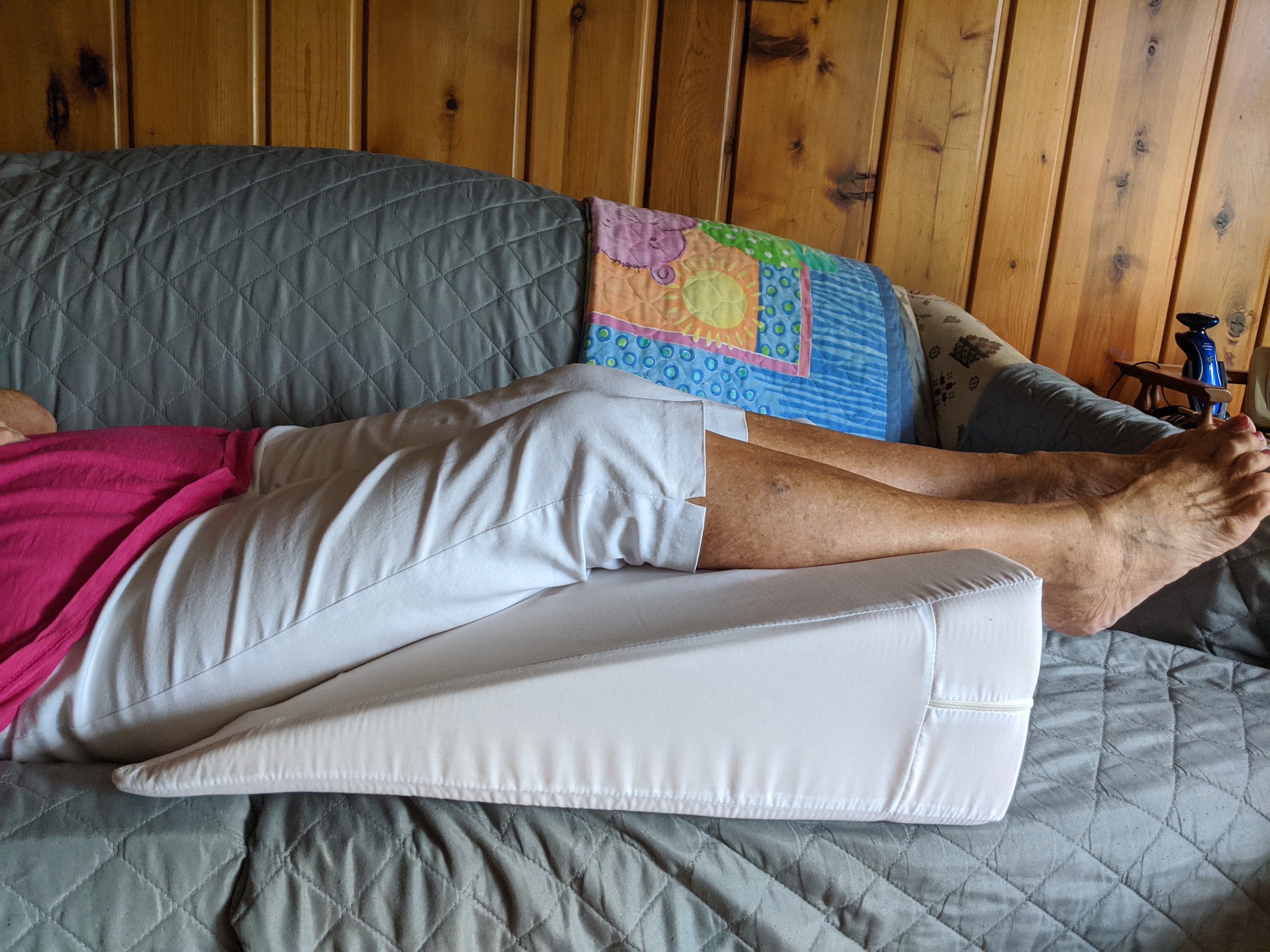
Dad sleeps with his calves and feet up on a wedge pillow to prevent his feet from getting bed sores. Basically, a wedge is a 2-foot long foam ramp. The lowest end of the “ramp” is slightly under Dad’s rump, and his heels hang over the higher edge.

Get that picture in your mind’s eye. (See photo below. And, no, those aren’t Dad’s legs.)

It was late morning, time to get up, so Sally Thompson, Audrey Walters, and I were chit-chatting with Dad. Audrey started pulling the wedge out from under him, but she was struggling because it remained wedged under his bottom.

So I grabbed a corner to help, and we pulled together until, hmph! the wedge finally came loose.

“It’s a boy, Mr. Pete!” Sally declared and we all laughed.

Then she quickly added, “It’s Sponge Bob!” We broke up! 🤣

My Friend Hubert

2018, Hubert Faulk and Bella

I miss my friend Hubert. Hubert Faulk. We were neighbors. That’s why I sometimes texted him as “2101” and he might text back as “317.” Every day Hubert texted his cadre of relatives and friends, each an individualized message. Once in the morning and again at night before he dozed off.

I’ve only ever known 2 Huberts, both of whom have lived within a block of my parents in Lumberton. And both of whom I inherited from my parents, whose friends they were first.

I’m especially missing Hubert Faulk today. With tropical storm Isaias headed our way, I walked down to his house to check for items that needed to be secured. Garbage containers, folding chairs, and the like. I took down his bird feeders after moving the trash and recycling bins into the carport.

Early this spring, Hubert’s daughter Jane installed a shepherd’s crook and 2 bird feeders as close to his big back windows as she could put them. So he could see them from his recliner. At my home, watching birds out the den picture window has become our primary daytime entertainment, and I’d strongly encouraged Hubert to join in with our hobby. He gave in after weeks of badgering.

Until about a year ago, Hubert was an outdoorsy man who took care of his own yard. He planted annuals and collards and turnips in little garden plots around his red brick ranch house. Twice he’d literally lost the skin on the top of his bald head by riding the lawnmower too close to the bar of his heavy concrete clothesline poles.

But Hubert didn’t mow his own lawn this year. Over the past couple of years, he’d been noticeably “slowing down,” as we politely say. Then, soon after 2019 became 2020, his engine was barely sputtering along. He hired a yard guy. And Jane shoveled in the soil to plant the wildflower seeds that her dad had bought.

A few months ago, Hubert became bed- and chair-bound. The social restrictions of covid-19 made his lack of mobility especially challenging. We’d wear our masks and yell at each other from across his den or in the shade of his carport.

With his old ears and ineffective hearing aids, Hubert might not hear what I said, but we’d talk at each other. We’d shake our heads at politics we didn’t like. We’d try to understand each other’s perspectives on social issues that we didn’t agree on.

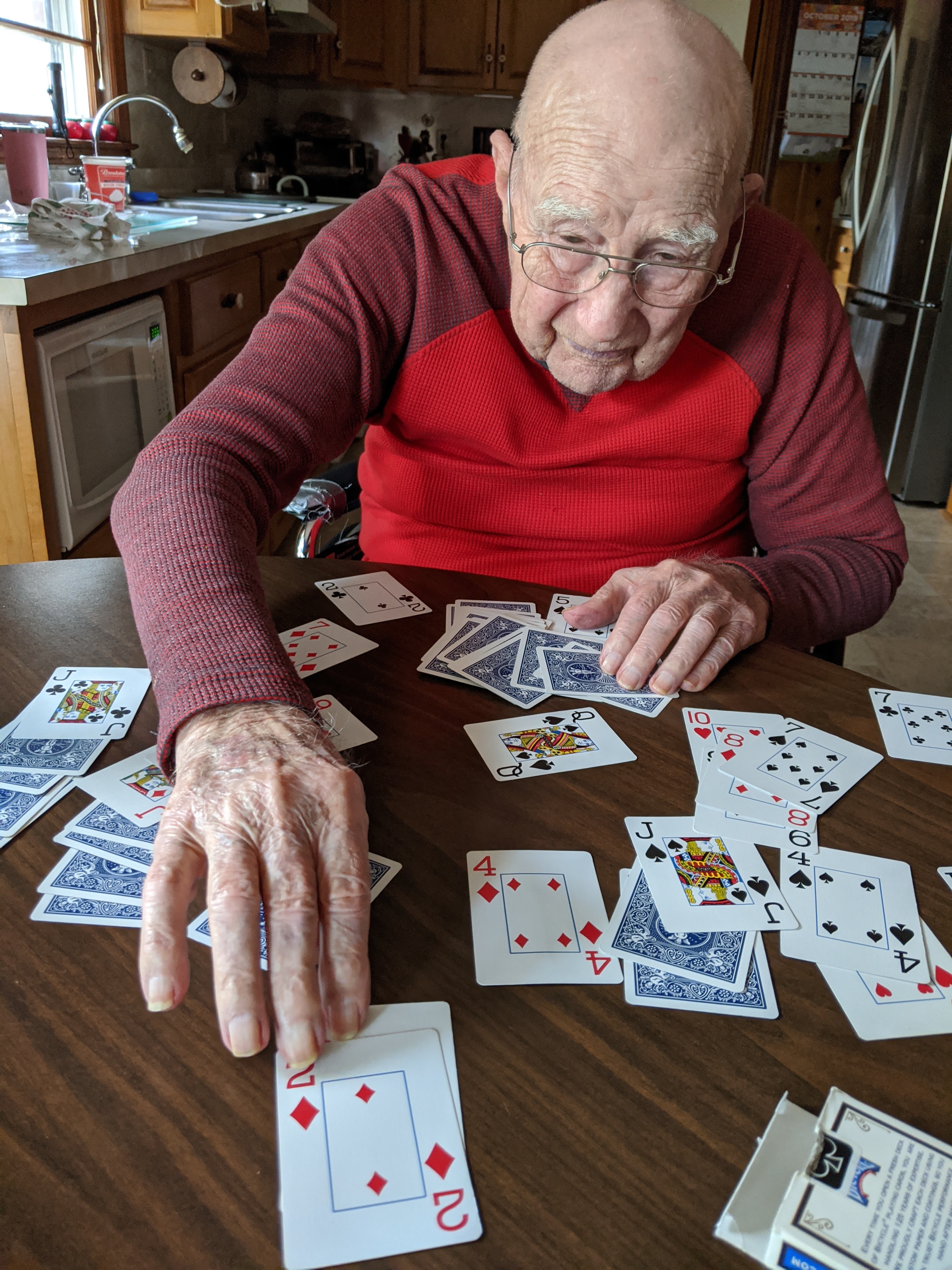
Over the years, Hubert and I talked and talked. About NASCAR and Godwin Heights Baptist Church and racism and the news. About how to repair bicycles and lawnmowers. About the good that my parents brought to their world, and how hard it was to watch them literally lose their minds. Since 2012, both Huberts had come to our rescue when Dad or Mom needed to be distracted from whichever worrisome places their minds had taken them to that day.

As you’d expect, Hubert talked about his daughters Jane and Priscilla and sons Alan and Sam, and his grandchildren and great-grands, and his sisters and their parents. And about my son’s family; Hubert would sometimes print Bastion’s sweet baby photos that I’d texted him.

Often Hubert talked about Rose, his Tootsie, whom he loved and lived with for nearly 60 years. And he’d cry as his love for her spilled out beyond what he could hold inside himself. During their marriage, he took care of her heart and she took care of his. Until, one day, no one could fix Rose’s heart. Then in July 2020, no one could fix Hubert’s heart either.

And I miss those sweet hearts. Especially today. And probably tomorrow, too.

How I Got Here

2017, James (Pete) and Louise Storms

I’m introducing myself today in order to put some of my future personal posts in context.

My career was in PR, marketing, recruiting, and sales. In 2004, I started Storms Associates, a 1-person recruiting company. Creative name, don’t you think? Recruiting required lots of uninterrupted time on the phone.

In mid-2012, I was living near the NC coast and had happily relaxed into life and business as a single woman – single again, I should clarify. I’d become a part of the community there and had just started dating a great guy. My son and daughter-in-law had married 3 months earlier. The economy was finally showing signs of pulling itself out of the Great Recession that began in 2008.

Things were going well.

2020, Dad.

Then, at 8:30 PM, life as I knew it changed Thursday, June 21, 2012. My parents’ neighbor, Amy called me. Dad had had a massive stroke and was in the ER at Southeastern Regional Medical Center in Lumberton. Amy was with them in the ER. She had made the call because Mom, who had Alzheimer’s, couldn’t always remember how to use the phone.

2016, Mom

June 21, 2012, was the night Lumberton NC became my residence, though I didn’t realize it at the time. I’d visited my parents many times since they moved there in 1995. I knew their neighbors and church friends, but I’d never lived there or stayed long.

Long story short, taking care of my then 81-year-old mother and 86-year-old father became my life. My career was over within a few months; for me it was impossible to pay attention to clients while caring for 2 parents with 2 entirely different types of dementia.

By the way, I’m an only child. My son, daughter-in-law, and grandson live in Texas. I have a large, loving extended family, some of whom live in nearby counties but most live at a distance. And that great guy I mentioned earlier – well, he’s still great and patiently in my life.

This is sometimes a stressful story, but it’s mostly happy. Mom and Dad get credit for that. They’ve always been kind, funny, frugal, and hard-working. And always filled with love and gratefulness.

What’s God’s Position on Masks?

This post is primarily for preachers, priests, rabbis, imams, and other religious teachers and leaders.

I wear a covid-19 mask.  Occasionally, I ask strangers in public places or public jobs why they do or don’t wear masks. In the last few weeks, a couple of people have responded that they don’t wear masks because they’re in God’s hands, or something to that effect.  

Religious leaders, I don’t know what your mask-wearing guidance has been to your congregations.  Perhaps you haven’t given any guidance. 

Maybe you agree that God will protect all righteous people, so they don’t need to take any precautions to protect themselves, their families, or their proverbial neighbors.

If not, please address this issue in your upcoming sermons and teachings.  Your message might save a life, if not a soul. 

I like being in my 60s

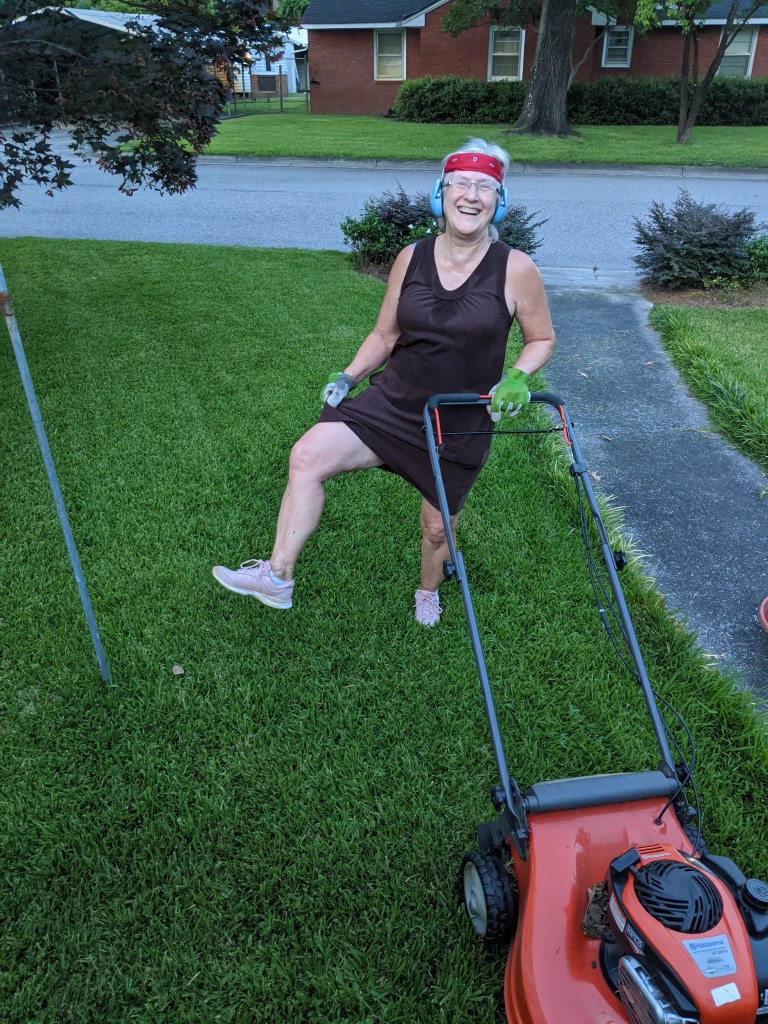
I do lots of thinking when I’m mowing the lawn. Last week I wore a short, sleeveless dress as I marched behind the mower. And I laughed at myself, thinking how ridiculous I must look working outside in a skirt.

Until recently, I would NEVER have worn a dress to work in the yard. Only old women might do that. Then I laughed again, realizing that I AM an old woman or, at least, an older woman.

And I realized that being in my 60s is freeing.

Expectations are low for people with gray or white hair, especially women. I get lauded for doing almost anything independent or productive. You mowed your lawn?!! Amazing. You walked 2 miles? Wow! You took an out-of-state trip by yourself? How brave! You gave a speech? What a memory! (Unfortunately, I rarely get praised for my cooking.)

No one expects me to accomplish great things anymore. There’s little or no pressure to perform – literally. In choir, it’s okay if my voice cracks or I run out of breath. Big, important jobs? Everyone assumes I’m no longer working. Proper grammar and educated opinions? Not necessary; most people are impressed if I’m just lucid.

Another thing I like about being older is that I’m free to wear whatever I wish because who cares if we look sexy? I no longer wear fitted business suits or high heels. Or pants and short skirts that are uncomfortable to sit in. Or bikinis in which I’d have to suck in my stomach. I wear flat shoes and sandals with good arch support and roomy toes, loose fitting blouses, swimming skirts to cover my broadening butt. No one cares. Once we’re “older,” who looks except to laugh or to say, “Isn’t she cute?”

Another good thing about being older is no more wolf whistles and the like. Years ago I stopped turning to look when a car beeped as I walked down the road. We older women are mostly invisible to the rest of the world, which can be annoying when people don’t pay attention to all our wise words. But that’s for another blog.

For the similar reasons, we can eat pretty much what we want to as long as we stay healthy and can fit into our wardrobes.

And the best, no more periods. No explanation necessary.

So, yes, I like being a kind-of-crazy woman in her 60s.